July 2026
Steam Bending
Our designs might have changed but the quality remains. ercol, since 1920.
Our chairs’ curved backs are a signature ercol design – and we still make them using the same traditional craft techniques as we did when we first produced them over 80 years ago.
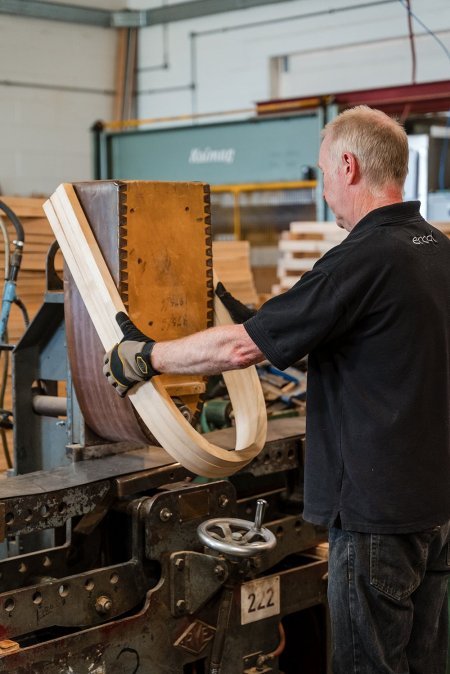
The steam bent back of a Quaker Dining Chair
The quick, easy way to make a curved chair back is to machine it. But here at ercol, we remain true to a tried-and-trusted craft method we perfected in the middle of the last century: steam-bending. Like many traditional crafts, it’s a subtle alchemy of tools and equipment, technique, and intangible but essential human qualities - instinct, judgment, a feel for the material and an understanding of the required result - that not even the most sophisticated CNC machine can replicate.
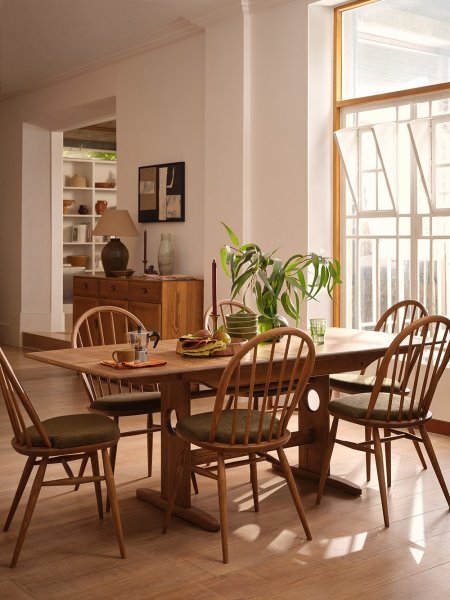
The iconic Windsor Dining Chair is a prime example of how the wood is curved to form the back bow of the chair
Steam bending is a complex, exacting and time-consuming process. So why do we stick with it? As with everything we make, we’re led by the material itself. Machining goes across the grain, where the timber is much weaker, and requires joints, which are also potential points of failure. By bending the timber, we eliminate joints and maintain the full integrity of the grain, and with it, all the structural strength nature endowed.
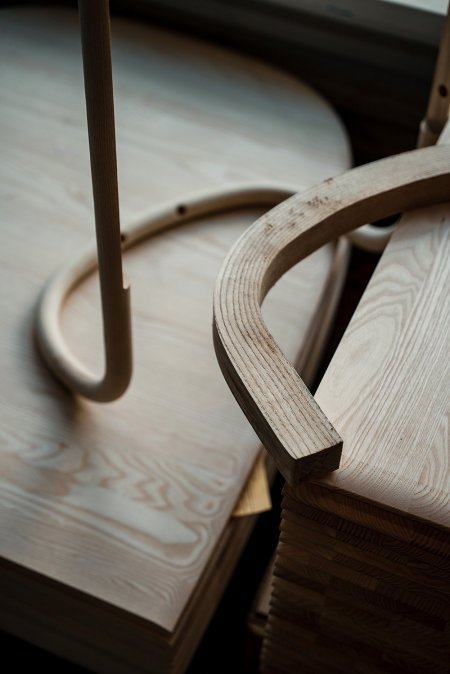
A comparison of when the piece of wood is first bent and how it is expertly sanded to form a piece of furniture
In steam-bending, moisture content is everything. It’s not the steam per se that bends the timber: what we're actually doing is using the steam, which we generate ourselves in a steam retort to heat the water inside the timber’s cells. The more water they contain, the more easily it bends. Hence, we want the moisture content to be as high as possible. The longer it’s in storage, the more moisture it loses by evaporation, so we always look to bend it as soon as possible when it arrives at our factory.
These days, we mostly bend ash. The skill lies in understanding that no two pieces of timber bend in the same way, even if they're from the same species. Where it was grown, the season in which it was felled, and even which part of the tree the timber comes from all affect how much moisture it contains.
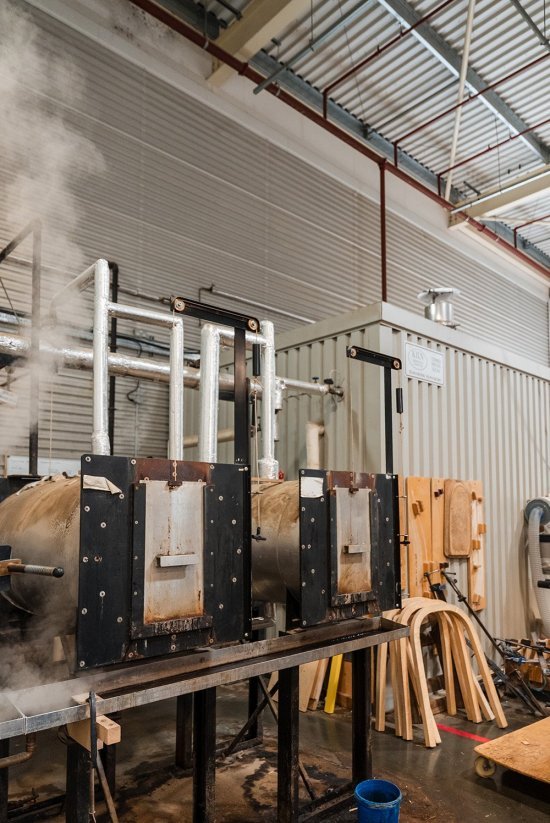
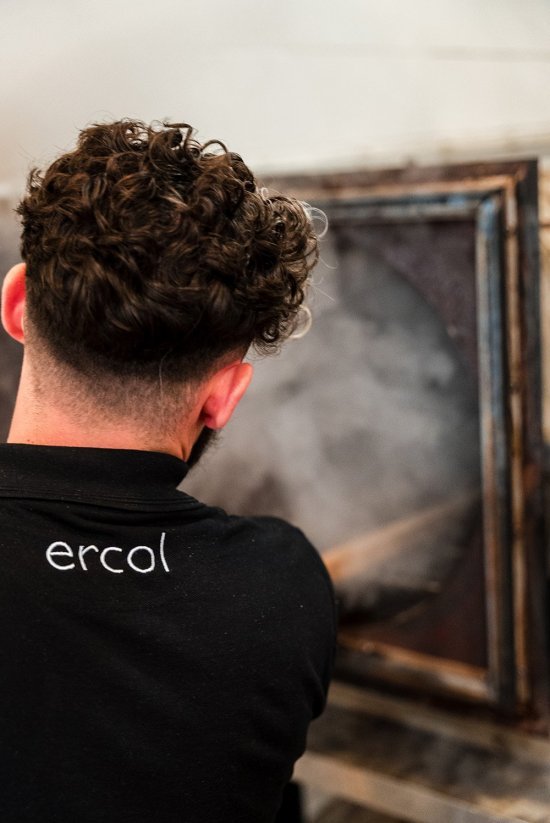
The large retort where the wood is steamed in for as little as 20 minutes before bending
In an ideal world, we would always work with good, straight-grained timber free of knots, which create points of weakness. That’s not always possible, of course, so we use different bending techniques for different types and sources of timber. New, unseasoned or ‘green’ timber has a high moisture content and can be bent into jigs by hand. Air-dried timber, which has a lower moisture content has to bent by machine. For kiln-dried timber, which has an even lower moisture content, and for certain species like maple, we use a radio frequency (RF) machine, similar to a microwave.
In all three methods, the most crucial skill is knowing how much end pressure to apply; in other words, the force exerted on the ends of the timber to bend it round. This has to be exactly right and, because every piece of timber is different, you can’t simply use a torque wrench or other machine: it has to be done by touch.
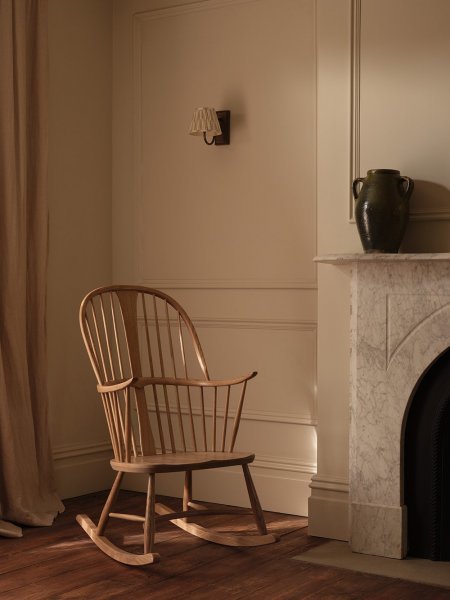
The Chairmakers Rocking Chair with a steam bent back bow
We also have to judge exactly how long each piece of timber needs to be steamed for. Depending on the species and the initial moisture content, this may be as little as 20 minutes, or as long as three hours. Here again the human eye and hand are crucial: leave ash steaming for too long and it can acquire a pinkish-purplish colour we don’t want.
Once the timber’s been bent, we need to dry it out so it retains its new shape. We do this in a large oven, where it remains for between 24 hours and two days at around 75°C. Though steady and slow, this is still quicker and more controlled than allowing it to dry naturally in the air.
Bending is an artificial, human process, and the wood's natural tendency is to want to return to its natural form (and will if its moisture content is high enough). In a curved chair back, that’s prevented by the joints securing it into the seat. The opposing forces create tension that actually adds to its strength. And rest assured: in normal indoor use, your chair back is never going to straighten itself out again!
If you would like to keep updated with the latest blogs, new arrivals and the latest offers from ercol, you can sign up to our newsletter here.